The Indian Army Ranks structure is a clear hierarchy that is necessary to maintain discipline, command-control, and operational effectiveness. The ranks are broadly categorized into three groups: Commissioned Officers, Junior Commissioned Officers (JCOs), and Other Ranks (Non-Commissioned Officers and Soldiers). Each rank comes with its own set of duties, responsibilities, and insignia that represent experience and authority.
Commissioned Officers
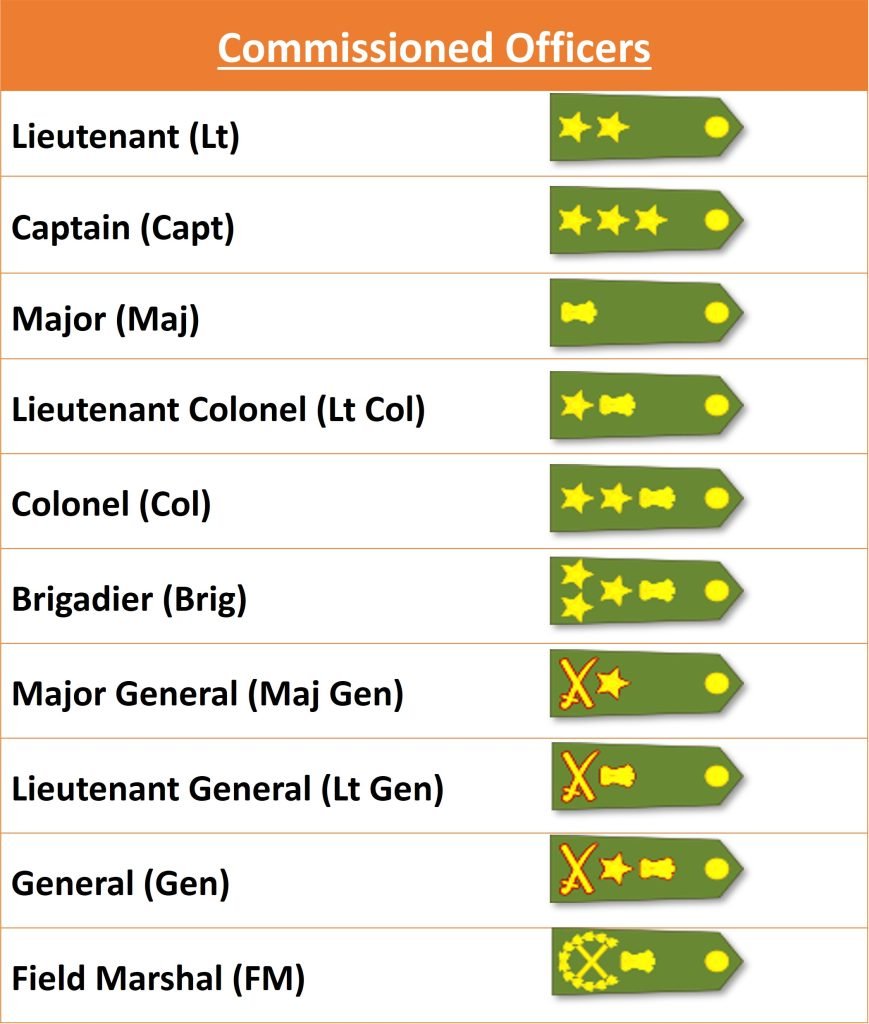
In the Indian Army Ranks, officers are the leaders of the army, responsible for commanding units from a small platoon to the entire army. Their insignia often includes stars and the national emblem
Lieutenant: Lieutenant is the most basic officer rank.. A Lieutenant commands a platoon of about 50 soldiers and is responsible for their day-to-day management, training, and welfare.
Captain: An important figure in tactical operations and planning, a captain leads a company of roughly 120 soldiers.
Major: A Major serves as a second-in-command of a battalion or leads a specialized unit. The insignia for this rank is the national emblem.
Lieutenant Colonel: A senior officer who commands a smaller unit or serves as second-in-command of a battalion.
Colonel: A Colonel commands a full battalion, overseeing its logistics, operations, and personnel.
Brigadier: A Brigadier in the Indian Army is a senior commissioned officer, ranked above Colonel and below Major General. It’s a one-star rank, and typically, a Brigadier commands a brigade, which consists of several battalions and support units.
Major General: This two-star officer is in charge of a division that has thousands of soldiers spread across several brigades.
Lieutenant General: A three-star officer who leads a corps, a very large formation of several divisions.
General: The highest attainable active rank. The General is the Chief of the Army Staff (COAS) and oversees the entire army.
Field Marshal: An honorary rank awarded for exceptional service. Sam Manekshaw and K. M. Cariappa are the only two Field Marshals in Indian Army history.
Junior Commissioned Officers (JCOs)
In the Indian Army Ranks, JCOs are a unique group that bridges the gap between the commissioned officers and the non-commissioned officers. They are experienced soldiers who have risen from the ranks to a commissioned status.
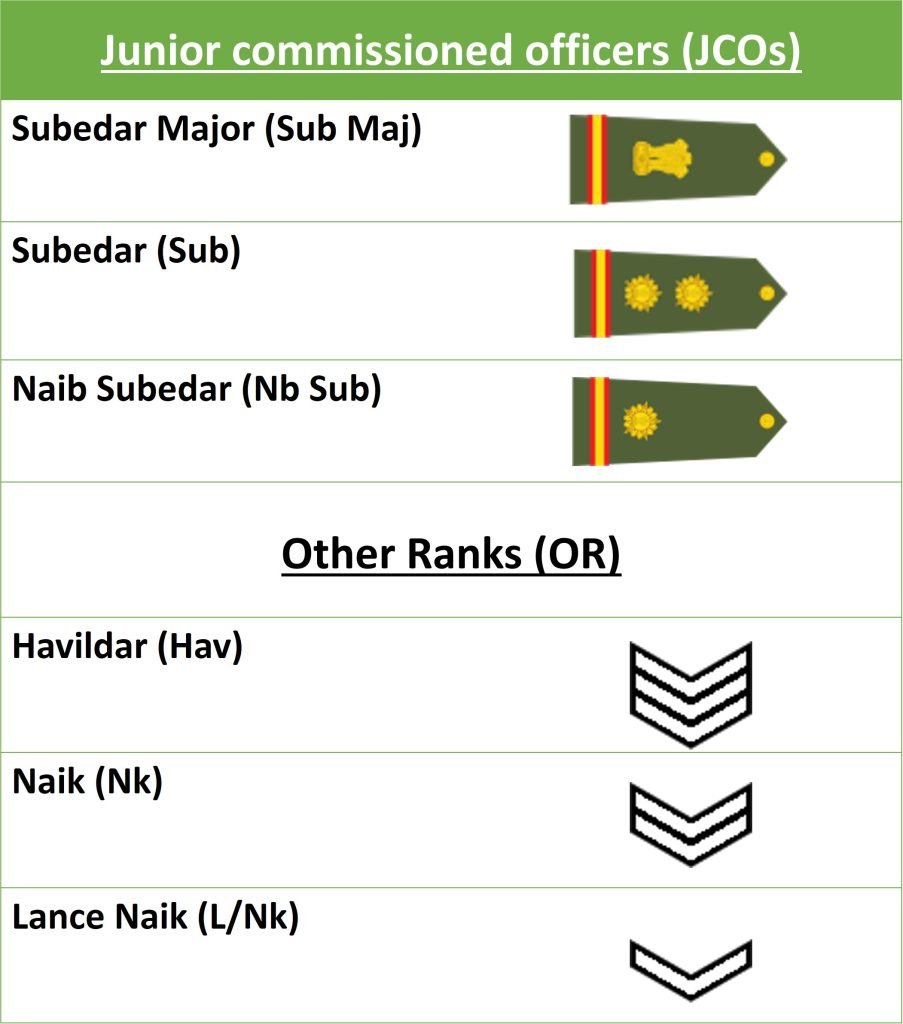
Naib Subedar: Acts as a bridge between commissioned officers and enlisted personnel. They often lead platoons and are responsible for the discipline, training, and welfare of troops. Usually promoted from the rank of Havildar based on merit, experience, and performance.
Subedar: A respected and experienced JCO who often serves as the moral compass of a unit. The insignia is two gold stars with a stripe.
Subedar Major: The most senior JCO is the Subedar Major. They advise the battalion commander on discipline, welfare, and operations.
Other Ranks (Non-Commissioned Officers and Soldiers)
Sepoy: In the Indian Army Ranks the lowest enlisted rank is Sepoy. Sepoys are the frontline soldiers who perform the primary combat duties. There is no insignia for this rank.
Lance Naik: A junior supervisory role, assisting higher ranks and leading small groups of soldiers. The insignia is a single chevron.
Naik: A non-commissioned officer responsible for leading a squad of 8 to 10 soldiers. The insignia is two chevrons.
Havildar: The most senior noncommissioned officer, a Havildar is in charge of training and disciplining a platoon of 20–30 soldiers. The insignia is three chevrons.
FAQ
- Commissioned Officers
- Junior Commissioned Officers (JCOs)
- Other Ranks (Ors
JCOs are promoted from the ranks of Non-Commissioned Officers (NCOs) based on their performance, seniority, and ability to pass promotion exams. They are seen as experienced and respected leaders who have risen through the ranks, bringing valuable field experience to their supervisory roles.
A Major is a mid-level commissioned officer who typically commands a company, which consists of about 120-150 soldiers. Their duties are multifaceted and include:
- Leadership and Command: Making critical operational decisions and ensuring the combat readiness of their company.
- Training and Discipline: Designing and overseeing training programs to ensure soldiers are proficient and disciplined.
- Administration: Managing logistics, equipment, and resources for their unit.
- Welfare: Ensuring the well-being and morale of their soldiers.
A Lieutenant General is a three-star commissioned officer who commands a corps, which is a large formation comprising multiple divisions (30,000-50,000 soldiers). They are responsible for shaping regional military strategies and guiding large-scale operations.